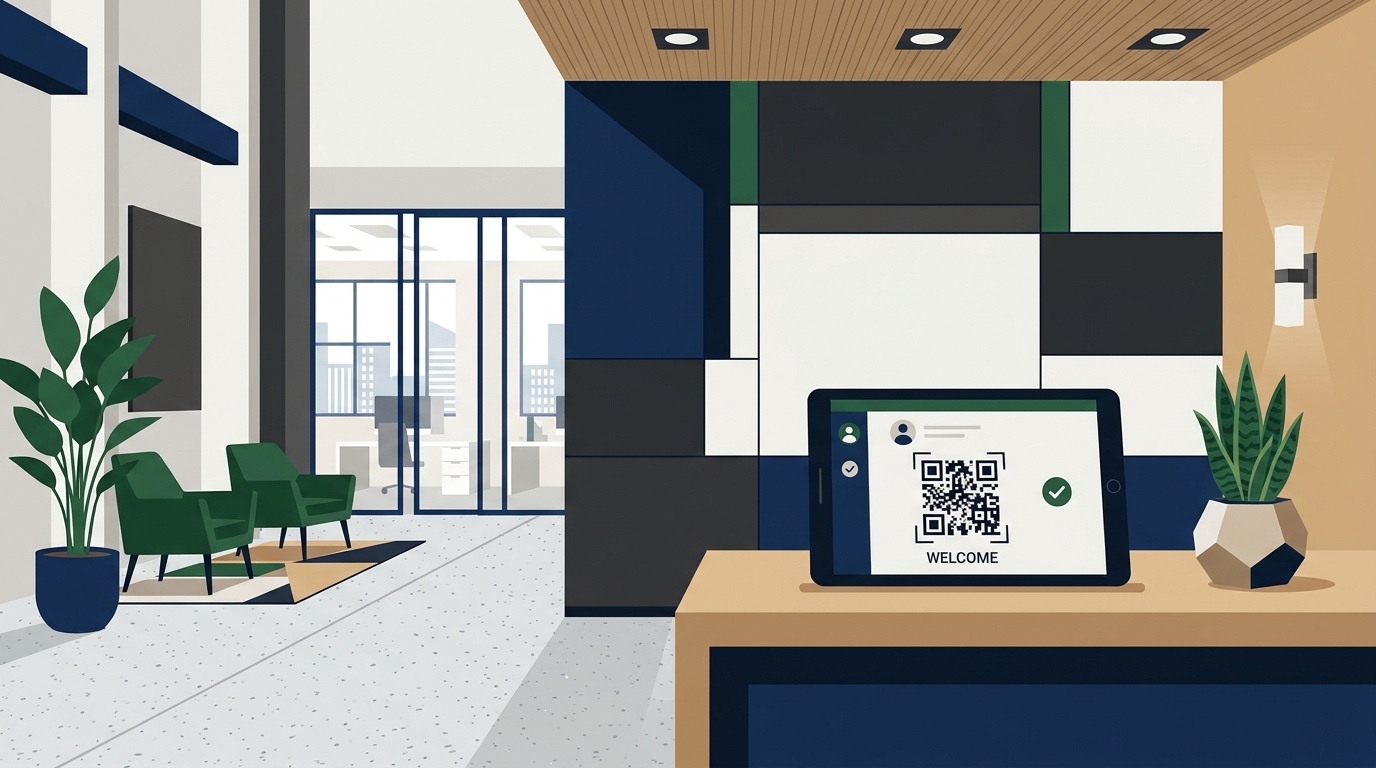
It is 9:15 AM on a Tuesday morning at a multi-tenant corporate plaza off Adeola Odeku in Victoria Island. The lobby is a hive of restless energy. Three dispatch riders are leaning against the marble counter, clutching thermal bags and shouting over each other to get the receptionist's attention. A high-value consultant from a firm in Abuja just arrived for a board meeting, looking visibly annoyed as he waits behind a job seeker who is struggling to remember the name of the HR manager he is supposed to see.
In the middle of this chaos sits the "Big Note." You know the one. It is that thick, dog-eared hardcover notebook with "VISITORS" scrawled across the front in permanent marker. The spine is held together by sheer willpower and office tape. Every person entering the building is forced to lean over the counter and scribble their name, phone number, and purpose of visit. The handwriting is usually an illegible crawl. Half the phone numbers are missing a digit. Most visitors simply write "Official" under the purpose of visit column.
As a facility manager or business leader, you might look at this scene and see a functioning process. I look at it and see a massive operational liability. That paper logbook is not just an eyesore. It is a security hole, a data privacy nightmare, and a bottleneck that is costing your organization more than you realize. If you are still running your front desk like it is 1995, your reception area does not just need a cleaning. It needs a complete digital makeover.
The Myth of the Paper Security Blanket
We have a cultural attachment to paper in Nigeria. There is a misplaced sense of security that comes from seeing a physical book at the security gatehouse or the front desk. We feel that if something goes wrong, we can always "check the book." But let's be honest about what happens when an actual incident occurs.
I once consulted for a manufacturing firm in Trans-Amadi, Port Harcourt. They had a minor equipment theft and needed to track every person who entered the facility over a forty-eight hour period. We spent three hours squinting at the visitor log. We couldn't tell if a name was "Bello" or "Bella." The time-out column was blank for eighty percent of the entries. The security guards had stopped enforcing the exit logs because the afternoon rush was too heavy.
A paper logbook provides the illusion of security without any of the utility. It doesn't verify identities. It doesn't alert anyone when a blacklisted individual tries to gain access. It certainly doesn't help you during a fire drill when you need to know exactly how many visitors are currently on the fifth floor of your Wuse 2 office. A digital system changes this dynamic instantly. When a visitor checks in via a tablet or a mobile link, the data is legible, timestamped, and searchable in seconds. You move from reactive guessing to proactive management.
The NDPA 2023 Reality Check
If the security argument doesn't move you, the legal one should. The Nigeria Data Protection Act (NDPA 2023) changed the rules of the game for every business operating in Lagos, Abuja, and beyond. Every time a visitor writes their personal phone number and home address in that open notebook on your counter, you are potentially violating their privacy rights.
Think about the person standing behind your current guest. They can easily look down and see the contact details of the CEO who just checked in. They can see who is visiting which company and at what time. In an era of rampant social engineering and identity theft, this is a goldmine for bad actors.
Under the NDPA, you have a responsibility to protect the personal data you collect. Leaving it exposed on a public-facing counter is the opposite of protection. Digital visitor management solutions like Entrifi solve this by ensuring that a guest's information is only visible to the authorized administrator. Once a guest submits their details on a screen, that information disappears from public view. You stay compliant, and your guests feel that their privacy is actually respected.
Solving the Intercom and Airtime Struggle
We have all seen the "receptionist dance." A visitor arrives, and the receptionist picks up the intercom to call the host. The intercom is dead. She tries the office landline; it is also down. Finally, she pulls out her personal smartphone to call the host on WhatsApp or mobile. Sometimes she has airtime; sometimes she doesn't. While she is navigating this, the queue at the front desk grows longer.
This is a uniquely Nigerian operational friction point. Our infrastructure is often unreliable, and we shouldn't build our first impressions on top of it. A digital makeover allows the system to do the heavy lifting. When a guest checks in, the system automatically sends an SMS or email notification to the host. No intercom required. No shouting across the lobby. The host gets a professional alert on their phone, and the receptionist can focus on being a brand ambassador rather than a human switchboard.
In high-traffic areas like the CBD in Abuja or the business hubs of Marina, this automation is a lifesaver. It removes the human error from the notification process. If the host is in a meeting at a different branch in Ikeja GRA, they still get the notification and can quickly delegate someone else to meet the guest. It keeps the flow of the office moving.
Handling the Morning Rush and Dispatch Chaos
The period between 8:30 AM and 10:00 AM is the ultimate test for any Nigerian front desk. This is when the corporate world collides with the logistics world. You have executive directors arriving for meetings, job seekers coming for interviews, and a parade of dispatch riders delivering everything from lunch to legal documents.
A manual system collapses under this pressure. The receptionist cannot verify everyone at once. A digital makeover allows you to categorize your traffic. You can have a dedicated "Fast Track" for frequent visitors or delivery personnel. Imagine a world where your regular dispatch riders have a QR code they scan to acknowledge a delivery, rather than spending five minutes arguing over a logbook.
This isn't about being fancy. It is about throughput. In places like Lekki Phase 1, where office space is expensive and lobbies are often cramped, you cannot afford to have people loitering because your check-in process is slow. You need to get people where they are going as quickly as possible.
Power Cuts and Technical Resilience
One of the biggest pushbacks I hear from facility managers in Nigeria is about power. "What happens when the gen is off?" or "What if the internet is slow?" These are valid concerns. We have all seen expensive, bulky kiosks imported from the UK or US that become useless bricks the moment there is a power surge or a dip in bandwidth.
This is why the "digital makeover" doesn't mean buying the most expensive hardware. It means choosing software that is built for our environment. A browser-based solution like Entrifi is ideal because it works on any device. If the main reception tablet is charging during a power transition, the receptionist can use a smartphone or a laptop.
Modern systems are designed to be "light." They don't need massive servers in your basement. They run on the cloud and can work over a basic 4G connection. By moving away from proprietary hardware and toward flexible software, you make your reception area more resilient, not less. You are no longer at the mercy of a single piece of equipment failing.
The Hidden Cost of "The Way We've Always Done It"
Business leaders often look at the cost of a digital visitor management system and compare it to the cost of a fifty-naira notebook. That is the wrong math. You have to look at the hidden costs of your current manual process.
Think about the time your HR team spends trying to track down a candidate who is stuck at the gate. Think about the security team's hours spent trying to compile monthly visitor reports by manually counting entries in a book. Think about the potential cost of an NDPA fine or the reputational damage when a VIP guest is treated like a nuisance because the receptionist is overwhelmed.
A digital makeover provides you with data. For the first time, you will know your peak visitor hours. You will know which departments receive the most guests. You will know exactly how long visitors are waiting in your lobby. This is the kind of operational intelligence that allows you to staff your reception correctly and optimize your facility's energy usage. If you know the building is empty of visitors by 4:00 PM on Fridays, you can adjust your operations accordingly.
Elevating the Brand Experience
First impressions are non-negotiable. Whether your office is in a sleek glass tower in Alausa or a converted townhouse in Maitama, the reception is the "handshake" of your company. When a guest walks in and sees a streamlined, digital check-in process, it sends a clear message: "We are organized. We are modern. We value your time and your privacy."
Compare that to the experience of being handed a dirty pen and told to "sign the book" while a security guard watches over your shoulder. One feels like a high-performing organization; the other feels like a government parastatal from the eighties. In a competitive market, these small cues matter. They influence how clients perceive your professionalism and how top talent views your company culture.
The transition doesn't have to be a headache. You don't need to shut down your lobby for a week or hire a team of IT consultants. You start by choosing a platform that fits your specific needs. You train your front desk staff not just on how to use the screen, but on how to guide guests through the new process. You'll find that most Nigerians are already tech-savvy enough to appreciate the change. We use apps for banking, for ordering food, and for hailing rides. We are ready for a digital reception.
The era of the dog-eared logbook is ending. The question is whether you will lead that change in your organization or wait until a security breach or a compliance audit forces your hand. Take a look at your lobby tomorrow morning. If you see a crowd of frustrated people hovering over a tattered notebook, you already have your answer. It is time for a makeover.